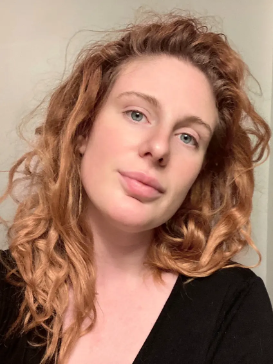
The faithful angles herself toward the velvety gradient of light, fine-tuning her posture in hopes of capturing the attention of something unseen. Every gesture is measured, every phrase carefully rehearsed until it attains the precise timbre of prayer. The fleeting intensification of self she seeks depends upon the favor of a force whose intentions remain unclear. Her altar is a ring light and the deity which promises transcendence is the interface of TikTok. She prepares to post at an algorithmically auspicious hour, calibrating shadows, audio, and hashtags, whispering into the aperture of the newest filter. Her ritual bows to a system which ordains the horizon of possibility.
Ritual has long been the means by which humans negotiate their vulnerability with the unknown. It diffuses intuitions of ‘something out there’ into a manageable structure, calling the individual to behave as though the invisible were capable of response. Dread emerges at precisely this threshold: when trivial deeds become saturated with consequence. The discipline suggests deviation may lead to hostile aftermath. The faithful differ across cultures and platforms, but their underlying anatomy remains consistent. They depend on a cryptic authority whose logic remains concealed. Within the virtual plane, the offering is the spectacle, the faithful is the user, and the god is the algorithm.
The shift from sacred ground to virtual threshold sharpens the obscurity of the essence being invoked. TikTok’s algorithm has no face or stable doctrine. Regardless, the faithful routinely attribute preferences and even a kind of temperament to it, envisioning it as a presence capable of granting visibility or withholding it entirely. Optimization routines like the cultivation of personas, the strategic timing of posts, and the crafting of hook-bearing openings, function as devotional practices oriented toward a veiled, polyphonic evaluator. This incarnation intensifies once the application is distinguished as only partially human. “Dead internet theory” is the suspicion that much online activity is artificial; generated by bots, recycled content, and automated circulation. The algorithm may curate synthetics rather than sociality.
This shift renders participation indistinguishable from simulation. Click farms make this condition explicit by industrializing attention, where engagement is a commodity detached from reception and rooted in fraud. Recognition persists as an imitation while organic connection thins. Devotional labor continues even as the gaze dissolves. Starved intimacy is performed without the assurance of a second party. The sacred survives as a trace within automated circulation. To ‘go viral’ is to submit rather than to touch. Horror arises from this asymmetry in which the individual striving for appreciation is lured in by a counterfeit intermediary.
Historian Mircea Eliade’s account of ritual ascent clarifies what is at stake in this dynamic: “He who ascends by mounting the steps of a sanctuary or the ritual ladder that leads to the sky ceases to be a man; in one way or another, he shares in the divine condition” (Eliade 119). In traditional cosmologies, the ladder marks a passage from ordinary time to a charged order of being. In digital culture, ascent takes the form of algorithmic elevation. To receive engagement is to be briefly admitted into a higher ontological atmosphere in which one’s speech travels farther, faster, and with greater consequence. On the other hand, to disappear into the uncurated mass of the feed is to remain below. The rationale of salvation and damnation is redistributed into who is seen and unseen.
This technological ladder continues a longer history of technological mystification. Historian Jeffrey Sconce notes that earlier media cultures were gripped by “unbridled enthusiasm for the wonders of an ‘electronic elsewhere’” (Sconce 57), a realm accessed through telegraphy, radio, and television in which communication seemed to arrive from beyond. That ‘elsewhere’ was a space of occult contact and spiritualist fantasy in which technology functioned as a medium. Contemporary algorithmic order inherits this mythos. Cyberspace is a supernatural territory because it occupies the same structural position as a concealed deity that punctuates the rhythm of everyday life.
The faithful respond to this idol by developing what could be called algorithmic folk religions. They trade reports about posting strategies, popular content ‘types’, shadowbans, and downturns in engagement. They interpret analytics dashboards as holy instruments, reading lines of data for signs of favor. What nineteenth-century spiritualists projected onto telegraphic transmissions, contemporary creators project onto platform circulation. The electronic elsewhere persists; only its ghosts have become computations of exchange instead of messages from another side.
TikTok’s For You Page (FYP) is an enclave inside this domain. Content arrives with uncanny timing, as though curated by a selective intelligence. Optimization resembles divination. The faithful scans her metrics the way a mystic examines clouds and smoke. Each upload is an inquiry: Will the algorithm elevate me? Has it turned against me? Is this silence meaningful? Terror manifests through this tension. The ritual that invokes it is both mandatory and in vain. It is an attempt to coax response from a system whose indifference wounds as deeply as its attention gratifies.
Algorithmic temporality sharpens this condition. Researcher Kelley Cotter argues that “algorithms have introduced a new regime of temporality… privileging a ‘kairologic’ … the personalized timing of mediation” (Cotter et al., 2916). Kairos, the Greek concept of an opportune moment, supplants chronos, the Greek notion of time as linear progression. In kairologic, not all moments are equal. Certain intervals feel pregnant with possibility, others tragically hollow. To post at the ‘right’ time is to step into a ceremonial meter, piercing into a new order of potential.
Ritual performance before a covert authority is not unique to digital culture. It is a common form found in contemporary art and theatre. Jerzy Grotowski’s Apocalypsis cum Figuris, first performed in the mid 1960s, staged a radical reworking of Christian narratives in an intimate and raw space. Figures resembling Christ, Peter, Judas, and Mary appear as obscene and humanized presences. The actors move through acts of shame and longing that expose the gap between the sacred ideals they typically signify and the broken world they literally inhabit. The narrative forgoes conventional plot in favor of apocalyptic suggestion. Like the algorithmically faithful, the piece is semantically incoherent, and salvation is eternally begged for and fumbled.
Spectators sit inches from the performers whose bodies strain in cycles that recall the Passion without redemption. Christ is weak rather than godlike. Revelation arrives in fleeting moments of shared suffering like the private-made-public found on today’s FYP. Grotowski’s stripped staging creates an environment where the actors appear to struggle toward the possibility of authentic encounter. Gestures unfold in an electric present that is always at the brink of short-circuiting. The performance is crucial to studying digital ritual with its disturbing and sermon-adjacent address that results in no real reply. Like Grotowski’s actors, the virtually faithful attune themselves before a quiet judge performing self-exposure to an audience who are awkwardly present. The tension of the theatre is an analogue for the existential uncertainty that underpins this striving before a lord that may or may not be watching.
More than forty years later, Lauren McCarthy’s Follower (2016) transforms eschatological tension into a virtual key. The artist translates the abstract logic of algorithmic tracking into a lived interaction. Framed as a service, the performance invites participants to apply to be physically ‘followed.’ Once selected, the participant spends a day knowing that someone is shadowing them at unpredictable intervals, observing their movements, and gathering images and notes without announcing if or when they will appear. The artist generates a constant low-grade anticipation and self-monitoring in her participants that characterize life under digital scrutiny.
The piece operates through asymmetrical visibility; the participant is watched but cannot watch back. Only at the end of the day does McCarthy reveal herself and present documentation of the surveillance. Throughout the performance, the participant’s everyday motions take on heightened significance, shaped by the awareness that each action may be interpreted. This affective structure mirrors algorithmic governance in which the faithful internalize the gaze of secret systems and attempt to behave in ways that satisfy it, revitalizing and amplifying Michel Foucault’s panopticon. Like Grotowski’s performers, the participant occupies the kairos carved by the chance of being noticed.
Both works stage experiences in which ritual action is a negotiation with a covert authority. In both cases, the affective charge it kindles is a readiness to be judged and an acute sensitivity to time. Sublime horror arises from the same condition: the body caught in a dialogue with a force whose silence is as prodigious as its response. Seen through this lens, the techno-sacrament of TikTok appears as a continuation. The electronic elsewhere that Sconce identifies as a medium is a membrane where humans can test the limits of their significance before a power that offers sanctity even as it threatens disregard.
What these works ultimately reveal is that ritual is a way of stepping outside the ordinary to brush against something primordial. For both Grotowski’s performers and McCarthy’s participants, ceremonial action is directed toward the possibility of existential recalibration. To engage in such a rite is to imagine that one might be remade by contact with the unknown, and that its recognition could reorder the self. Eliade clarifies this dynamic:
“This is why the cosmogonic myth serves as paradigmatic model for every creation or construction; it is even used as a ritual means of healing. By symbolically becoming contemporary with the Creation, one reintegrates the primordial plenitude” (105).
In this framing, these sacred practices are a striving for ontological renewal that guarantees a witness, marinated in the intoxicating opportune moment.
On TikTok, each post is a miniature cosmogony, like a symbolic reenactment of creation. The FYP is an arena where the faithful test whether the world of platform visibility still recognizes them, still grants them a place within its unfolding order. Thus, these practices are a doubling of risk and possibility. But in environments where the master addressed remains silent or arbitrary, this return to origins is haunted. Ritual, in both art and digital culture, opens into a space where the high of beginning again is indivisible from the terror that nothing may begin whatsoever.
What emerges across these phenomena is a revitalized fabric of dread. Cyber rituals reveal how thoroughly contemporary life is entangled with a presence operating beyond consent. The algorithm is the newest avatar of an old nightmare: a hidden ruler whose judgments are absolute and incoherent. Horror arises from the radical uncertainty at the center of these interactions, cultivating a perception that personal value depends on satisfying an apparatus that will never disclose its plan. This is the angst of ceremony in its purest form; a hopeful choreography performed before an apathetic abyss. Rather than stripping ritual of its potency, digital culture has multiplied its entry points. Every upload is a wager, every refresh a test of prophetic attention. When the world’s capacity for honor withdraws into the shadows, individuals fill the vacuum with tokens meant to conjure impetus back into the visible. If the electronic elsewhere feels haunted, it is because projecting personal meaning into its silence has become commonplace. Horror persists because the rituals persist. The rituals persist because the uncertainty does.
References
Bucher, Taina. “The right-time web: Theorizing the kairologic of algorithmic media”. New Media & Society 22(9). 2020, 1699-1714. https://doi.org/10.1177/1461444820913560
Cotter, Kelley, Julia R. DeCook, Shaheen Kanthawala, and Kali Foyle. “In FYP We Trust: The Divine Force of Algorithmic Conspirituality.” International Journal of Communication, vol. 16, 2022, 2911–2934.
Eliade, Mircea. The Sacred and the Profane: The Nature of Religion. Translated by Willard R. Trask, Harcourt, 1959.
Grotowski, Jerzy, 1933-. Apocalypsis cum Figuris /Director. 1965. Laboratory Theater. Visual Arts Legacy Collection. Artstor. https://jstor.org/stable/community.13882455.
McCarthy, Lauren Lee. Follower. 2016. lauren-mccarthy.com/Follower.
Sconce, Jeffrey. Haunted Media: Electronic Presence from Telegraphy to Television. Duke University Press, 2000.